Web Design & Development
The Ultimate Guide to Branding Pricing: Costs & Tips for 2024

Matthew Johnson
Founder

At Peak Digital Studio, most of our early clients came through referrals, word of mouth, and old-fashioned networking. Like a lot of service businesses, we tried cold email a few different times using tools like Apollo and Instantly. We even hired a service that promised to manage cold outreach for us, charging per call booked.
After a hefty setup fee and exactly zero calls booked after three months, I wrote the whole category off as a scam.
The all-in-one tools were fine at managing email sequences, but the underlying problem was always the same. The lead data felt stale, the targeting was loose, and doing outreach at scale meant sacrificing the personalization that actually makes cold email work. Most of the AI features tried to paper over that gap, but the results still felt generic and easy to ignore.
For a while, I figured cold email just wasn’t for me.
I’ve been a Zapier power user for over a decade, building automations long before “AI workflows” were a thing. But until recently, I mostly stuck to classic Zaps. I’d log in, see the new AI Agent features, think “I should try that sometime,” and move on.
Last week, I finally made the time. Within days, it fundamentally changed how I think about outbound, and this cold email workflow more than any other.
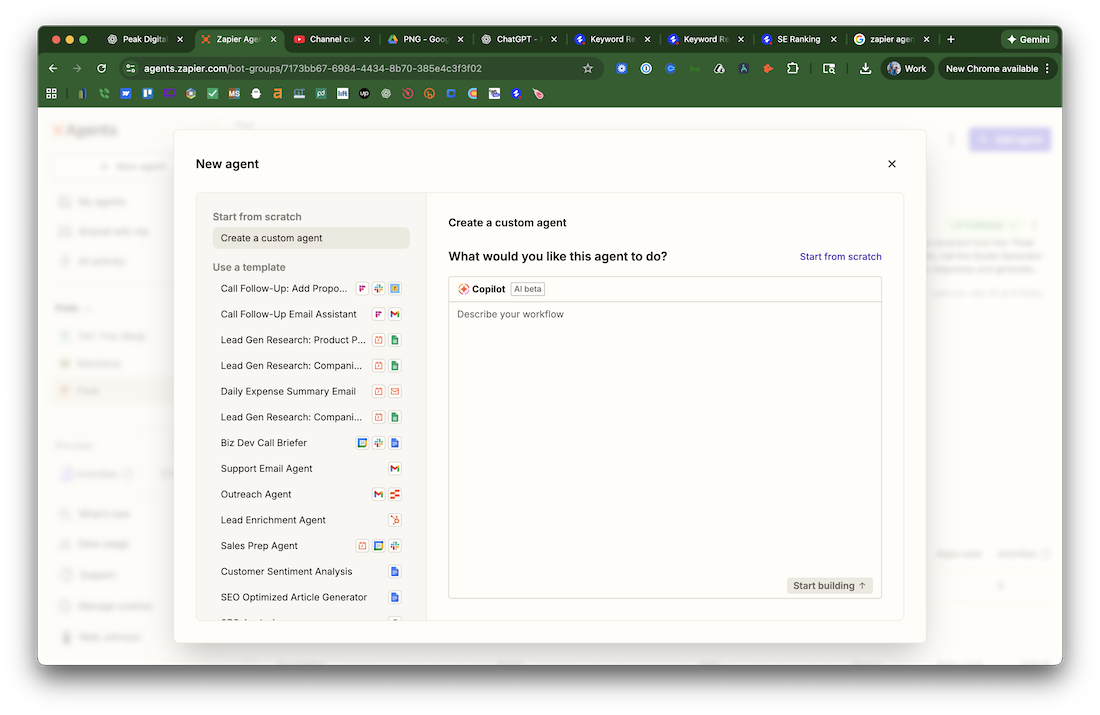
Zapier AI Agents are essentially small, focused workers you assign a specific role. Instead of building one massive automation that tries to do everything, you create an agent, define its job, give it context and rules, and let it operate inside your workflow.
The key shift for me was realizing that agents are proactive, not reactive. This isn’t like ChatGPT or other LLMs where you open a chat, ask a question, get a response, and then decide what to do next. With agents, you give instructions once, and they go out and do the work for you. They run on schedules, watch for new data, make decisions, and take action without needing constant prompts.
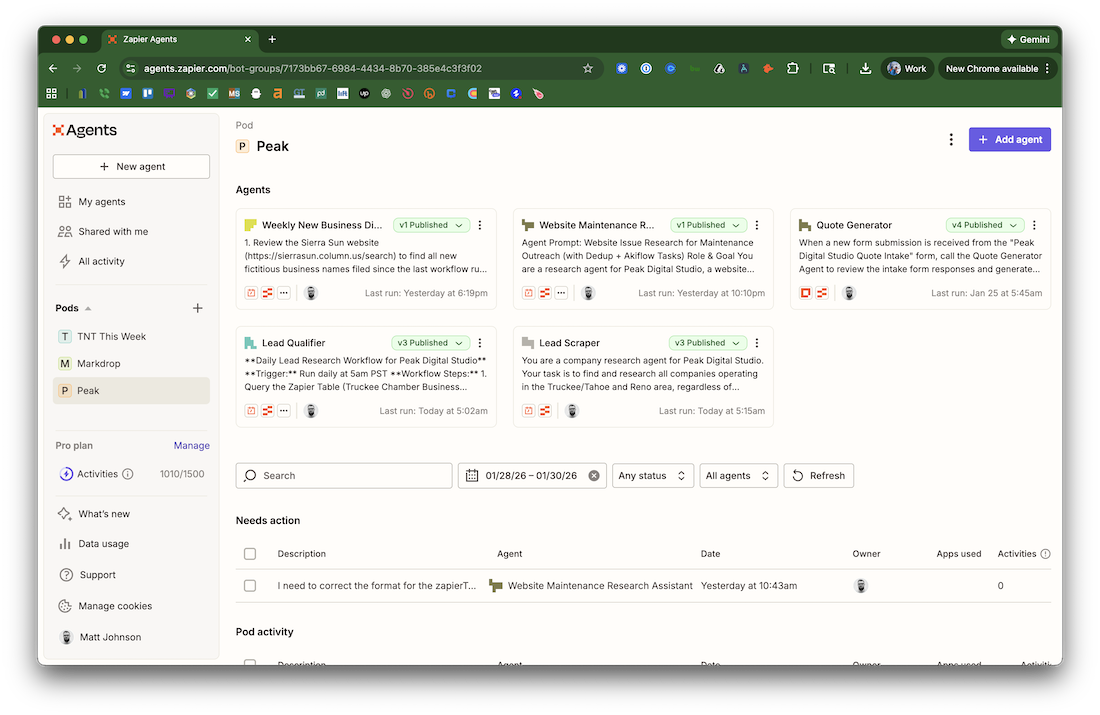
In practice, they behave more like junior teammates than tools. One agent’s job is to continuously find local businesses. Another agent’s job is to look at those businesses and decide whether they’re actually worth reaching out to. I’m not chatting with them. I’m setting the rules, guardrails, and expectations up front and letting them operate quietly in the background as part of a real system.
This is what made agents feel fundamentally different from the outreach tools I’d tried before. Instead of relying on stale databases scraped from LinkedIn years ago, these agents use the same kinds of signals a human would: Google searches, real websites, and recent activity. They’re mimicking how I would do the work myself, just at a scale I could never manage manually.
This approach follows what I think of as a “build small, connect later” mindset. Rather than designing one perfect automation upfront, I built small, single-purpose pieces and made sure each one worked on its own. One agent finds businesses. Another qualifies them. Tables store data. My task manager handles daily action. Once those pieces were solid, I connected them together. The result is a system that’s easier to understand, easier to debug, and much easier to improve over time.
The entire process runs mostly inside Zapier, with a few supporting tools where they make sense. It starts with a simple lead database built using Zapier Tables, which is essentially Zapier’s version of a spreadsheet. This table acts as the source of truth for every company I might reach out to.
To seed that database, I scraped a variety of local business directories using a browser-based tool called Axiom. The goal wasn’t perfection, it was coverage. I wanted as many real, local businesses as possible in one place. From there, I set up an agent whose only job is to continuously look for new local businesses that aren’t already in the table. That agent runs daily, so the lead list grows automatically over time without any manual effort.
Next, a second agent handles qualification. I gave it a clear ideal customer profile based on Peak Digital Studio: company size, industry, and the kinds of websites we’re a good fit for. It doesn’t just rely on surface-level data. The agent actually visits each company’s website to assess whether it feels modern, maintained, and effective, or whether it’s clearly outdated and could use improvement.
When a lead passes that filter, it’s added to Attio*, which we use as a CRM, and a task is automatically created in Akiflow*, my daily task manager. This is where the system really clicks. Each morning, I open Akiflow and see a short list of qualified leads that are ready for outreach.
Each task includes everything I need to send a thoughtful email without starting from scratch: the company name, website, contact details, a suggested outreach angle, and specific notes about what could be improved on their site. I still write every email myself, using short snippets for the intro and outro in Superhuman*, but the hard thinking is already done. I’m not deciding who to email, what to say, or whether it’s worth my time. I’m just executing.
That’s the real point of this system. The agents aren’t replacing the human part of sales. They’re handling the repetitive research and decision-making so that every outreach task is already “ready to send.”
Within the first week, this workflow booked four sales calls. The return on time spent is dramatically better than the automated tools I tried before, which were more expensive and far less effective. It’s the only cold email approach that’s consistently worked for me since starting Peak.
I’m also getting thoughtful replies even when a lead isn’t ready to start a project. In many cases, people thank me for the specific feedback on their site and ask to stay in touch for the future. That alone is a huge shift from being ignored or flagged as spam.
Just as importantly, this approach avoids blasting emails at the wrong people. The volume stays reasonable, the targeting stays tight, and the outreach doesn’t trip spam filters or damage reputation.
The biggest reason this works is that lead generation and outreach are treated as two separate problems. Most tools try to do everything at once, which usually results in mediocre leads paired with generic messaging. By separating the two, I can focus first on finding and qualifying the right companies, and only then worry about how and when to reach out.
Because the logic lives inside my own agents, the system mirrors my actual decision-making instead of relying on canned AI copy. The agents look at real signals like website quality and business fit, not outdated data points scraped years ago. That makes the outreach more relevant, better timed, and far more human, which is why it gets replies instead of getting filtered out.
This setup works particularly well for service businesses where outbound still matters but volume-based tactics fall flat. It’s a strong fit for agencies and consultants who need to stay personal and relevant, solo founders who are doing their own outreach and can’t afford to waste time, and anyone who wants leverage from automation without turning into a spam machine.
This is, in my opinion, the best version of AI-assisted outbound available right now. The agents aren’t trying to pretend they’re human or replace me. They’re doing research at scale and surfacing the best opportunities with the context I need to reach out thoughtfully.
People are getting better at recognizing AI-generated outreach, which means the last mile still needs to be human. Agents can get you most of the way there, but the relationship-building, judgment, and tone still matter.
Why this approach scales without feeling gross comes down to intent and restraint. The system isn’t designed to send as many emails as possible. It’s designed to help me send fewer, better emails to the right people. By focusing on relevance and qualification first, I’m reaching out with context, specific feedback, and a legitimate reason to start a conversation. That keeps the process effective, sustainable, and human, even as it scales.
If you find this kind of practical, real-world automation useful, consider subscribing to the Peak newsletter or YouTube channel. I’ll keep sharing workflows like this as I build and refine systems inside Peak.
And if you’re interested in building something similar for your own business, feel free to reach out. We help teams set up Zapier automations and agent-driven workflows tailored to how they actually work.
You can learn more about Peak Digital Studio at peakdigitalstudio.com. If you'd like to start an automation project with us, book a call with me!